![[Search]](/static/images/search.gif)
![[A-Z Index]](/static/images/az.gif)
![[Contact]](/static/images/contact.gif)
![[University of Cambridge]](/static/images/identifier2.gif)
![[Talks.cam]](/static/images/talkslogosmall.gif)


 Thursday 03 November 2022, 18:10-19:30

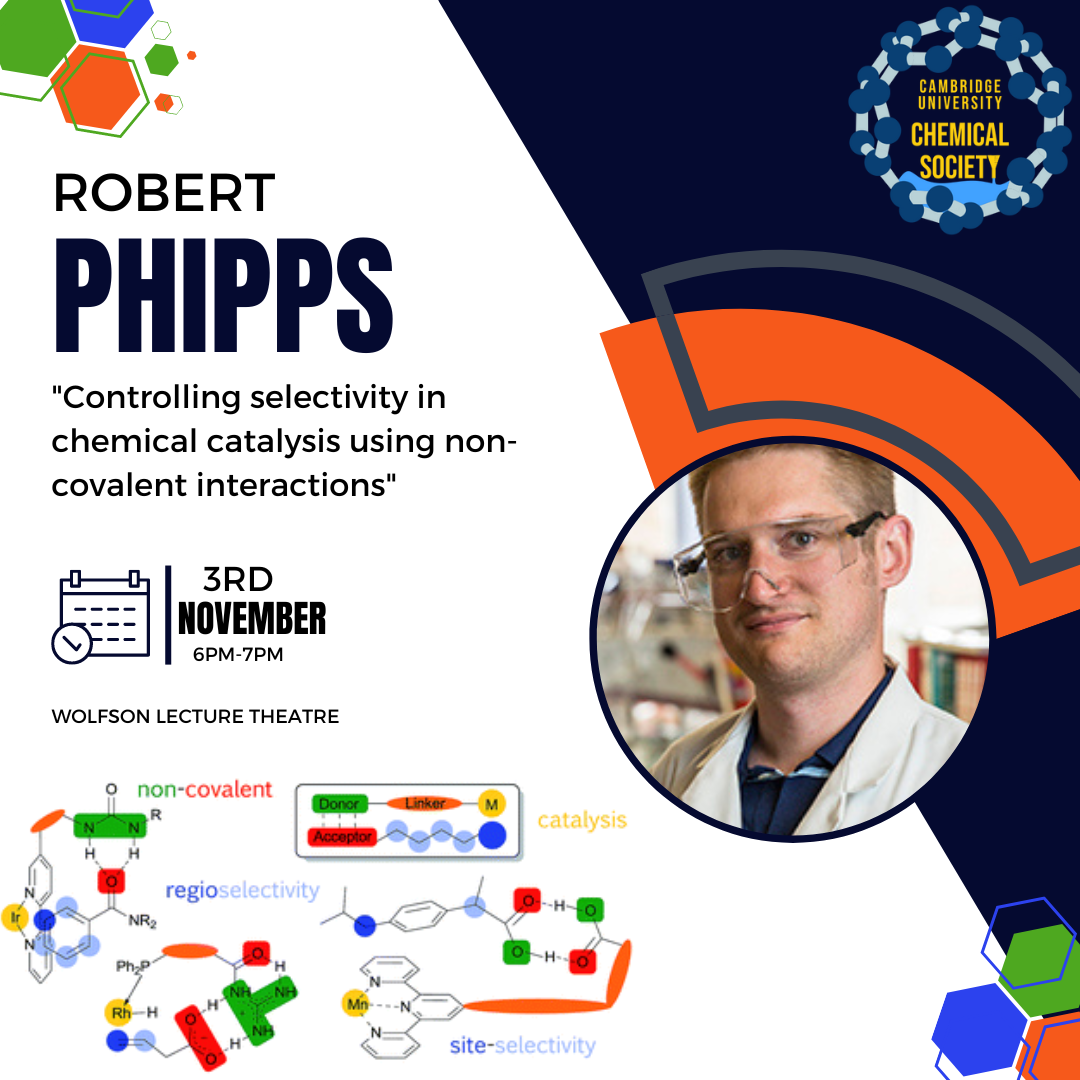
Controlling selectivity in chemical catalysis using non-covalent interactions
- 👤 Speaker: Dr. Robert J. Phipps (University of Cambridge)
- 📅 Date & Time: Thursday 03 November 2022, 18:10 - 19:30
- 📍 Venue: Dept of Chemistry, Wolfson Lecture Theatre
Abstract
This lecture will describe our research program which seeks to develop new catalytic strategies based on attractive non-covalent interactions to tackle selectivity challenges in modern synthetic methodology. Non-covalent interactions play a crucial role in all manner of chemical and biological processes. In recent times, the incorporation of non-covalent interactions into the design of small molecule catalysts has revolutionised the field of enantioselective catalysis. Our research is centered around applying catalyst designs incorporating non-covalent interactions to tackle foremost selectivity challenges in synthetic chemistry, concerning both positional selectivity and enantioselectivity.
The lecture will describe initial projects focussed on the challenge of site-selectivity which commenced with the development of a bifunctional ligand based on ion-pairing for controlling site-selectivity in iridium-catalysed borylation. We have subsequently applied a bifunctional ligand strategy to control site-selectivity in Suzuki-Miyaura couplings of substrates bearing multiple instances of the same halide, in this case using a sulfonated phosphine. Subsequent investigations will be described which probe the feasibility of using the chiral cation associated with the ligand as the sole source of chirality to achieve an enantioselective remote borylation of a symmetrical substrate and describe how we were able to realise the desymmetrising borylation on two distinct classes of substate, to form both chiral-at-carbon and chiral-at-phosphorous compounds. This approach has been further applied to Rhodium catalysed C-H amination. We synthesised an anionic version of Rh2(esp)2 and have shown that, when paired with chiral cations, this catalyst gives excellent enantioselectivies for C-H amination of substrates bearing a pendant hydroxy group, which we believe interacts with the catalyst sulfonate group through hydrogen bonding.
Series This talk is part of the Chemical Society Talks series.
Included in Lists
Note: Ex-directory lists are not shown.